
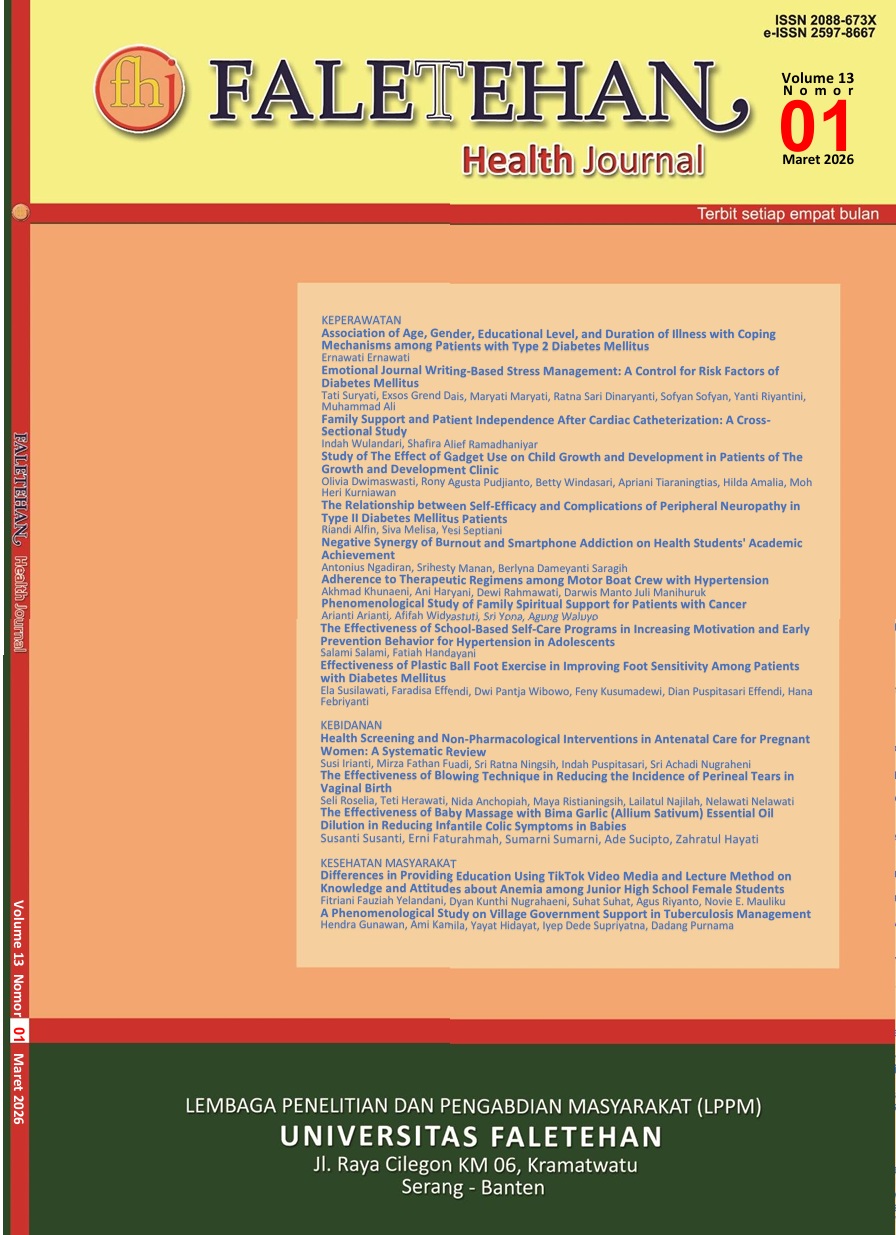
Study of The Effect of Gadget Use on Child Growth and Development in Patients of The Growth and Development Clinic
DOI:
https://doi.org/10.33746/fhj.v13i01.818Keywords:
children under five, developmental delay, gadget, growth and developmentAbstract
Children aged five and under are often overexposed to gadgets, despite the fact that early childhood is a critical period for cognitive, language, motor, and socio-emotional development. Uncontrolled gadget exposure is feared to negatively impact children's growth and development. The purpose of this study was to determine the relationship between gadget use and child development. This study used an observational analytical design with a cross-sectional approach. The sampling technique used was total sampling with a sample size of 30 children patient aged 3-5 years. The study was conducted from January 2-15, 2024 in a growth and development clinic. Data were analyzed using the Spearman statistical test. The results of this study showed that the majority of children used gadgets daily (76.7%) with a frequency of use three times per day (33.3%). Developmental measurements showed that the majority of children were in the developmental deviation category (83.3%). The results of the statistical test showed a significant relationship between gadget use and developmental disorders (p-value 0.007). The more frequently a child uses gadgets, the greater the likelihood of experiencing developmental disorders (r = 0.480). Limiting and monitoring gadget use is necessary to prevent disruption to a child's development. Parents, healthcare professionals, and the government need to work together to create an environment that supports optimal child growth and development.
Downloads
References
Abdissa, D., Hamba, N., Kene, K., Bedane, D., Arumugam, C. T., Said, M. A., & Nik Farid, N. D. (2021). Screen-based media and young children: Review and recommendations. Malaysian Family Physician: The Official Journal of the Academy of Family Physicians of Malaysia, 16(2), 7–13. https://doi.org/10.51866/rv1143
Chaibal, S., & Chaiyakul, S. (2022). The association between smartphone and tablet usage and children development. Acta Psychologica, 228, 103646. https://doi.org/https://doi.org/10.1016/j.actpsy.2022.103646
Chang, F.-C., Chiu, C.-H., Chen, P.-H., Chiang, J.-T., Miao, N.-F., Chuang, H.-Y., & Liu, S. (2019). Children’s use of mobile devices, smartphone addiction and parental mediation in Taiwan. Computers in Human Behavior, 93, 25–32. https://doi.org/https://doi.org/10.1016/j.chb.2018.11.048
Children and parents: Media use and attitudes report. (2017).
Choo, Y. Y., Yeleswarapu, S. P., How, C. H., & Agarwal, P. (2019). Developmental assessment: practice tips for primary care physicians. Singapore Medical Journal, 60(2), 57–62. https://doi.org/10.11622/smedj.2019016
Cliff, D. P., McNeill, J., Vella, S. A., Howard, S. J., Santos, R., Batterham, M., Melhuish, E., Okely, A. D., & de Rosnay, M. (2017). Adherence to 24-Hour Movement Guidelines for the Early Years and associations with social-cognitive development among Australian preschool children. BMC Public Health, 17(Suppl 5), 857. https://doi.org/10.1186/s12889-017-4858-7
Council on Communications and Media. (2016). Media and Young Minds. Pediatrics, 138(5). https://doi.org/10.1542/peds.2016-2591
Hosokawa, R., & Katsura, T. (2018). Association between mobile technology use and child adjustment in early elementary school age. PLOS ONE, 13(7), e0199959. https://doi.org/10.1371/journal.pone.0199959
Hutton, J. S., Dudley, J., Horowitz-Kraus, T., DeWitt, T., & Holland, S. K. (2020). Associations Between Screen-Based Media Use and Brain White Matter Integrity in Preschool-Aged Children. JAMA Pediatrics, 174(1), e193869–e193869. https://doi.org/10.1001/jamapediatrics.2019.3869
Kementerian Kesehatan RI. (2016). Pedoman Pelaksanaan Stimulasi, Deteksi dan Intervensi Dini Tumbuh Kembang Anak.
Madigan, S., Racine, N., & Tough, S. (2020). Prevalence of Preschoolers Meeting vs Exceeding Screen Time Guidelines. JAMA Pediatrics, 174(1), 93–95. https://doi.org/10.1001/jamapediatrics.2019.4495
Lilis, Aulia, Rifda, Saroh, U., & Musthofa, M. B. (2024). Strategi Pengelolaan Lingkungan
Belajar Outdoor di Paud. Dunia Anak: Jurnal Pendidikan Anak Usia Dini, 07(02), 102 114. https://doi.org/https://doi.org/10.31932/jpaud.v7i2.3577
McArthur, B. A., Volkova, V., Tomopoulos, S., & Madigan, S. (2022). Global Prevalence of Meeting Screen Time Guidelines Among Children 5 Years and Younger: A Systematic Review and Meta-analysis. JAMA Pediatrics, 176(4), 373–383. https://doi.org/10.1001/jamapediatrics.2021.6386
Qu, G., Hu, W., Meng, J., Wang, X., Su, W., Liu, H., Ma, S., Sun, C., Huang, C., Lowe, S., & Sun, Y. (2023). Association between screen time and developmental and behavioral problems among children in the United States: evidence from 2018 to 2020 NSCH. Journal of Psychiatric Research, 161, 140–149. https://doi.org/10.1016/j.jpsychires.2023.03.014
Quick, V., Martin-Biggers, J., Povis, G. A., Hongu, N., Worobey, J., & Byrd-Bredbenner, C. (2017). A Socio-Ecological Examination of Weight-Related Characteristics of the Home Environment and Lifestyles of Households with Young Children. Nutrients, 9(6). https://doi.org/10.3390/nu9060604
Radesky, J. S., & Christakis, D. A. (2016). Increased Screen Time: Implications for Early Childhood Development and Behavior. Pediatric Clinics of North America, 63(5), 827–839. https://doi.org/10.1016/j.pcl.2016.06.006
Rideout, V., & Robb, M. B. (2020). The Common Sense census: Media use by kids age zero to eight, 2020. https://www.commonsensemedia.org/sites/default/files/research/report/2020_zero_to_eight_census_final_web.pdf
Sigman, A. (2017). Screen Dependency Disorders: a new challenge for child neurology. Journal of the International Child Neurology Association, 1(1 SE-Review Articles). https://doi.org/10.17724/jicna.2017.119
Swatika, P. (2018). Pengaruh Penggunaan Gadget Terhadap Perkembangan Psikologi Anak. Holistika: Jurnal Ilmiah PGSD, 2(1), 49–54. https://jurnal.umj.ac.id/index.php/holistika/article/view/2878
Tomlinson, M., Cooper, P., & Murray, L. (2005). The mother-infant relationship and infant attachment in a South African peri-urban settlement. Child Development, 76(5), 1044–1054. https://doi.org/10.1111/j.1467-8624.2005.00896.x
Vally, Z., Murray, L., Tomlinson, M., & Cooper, P. J. (2015). The impact of dialogic book-sharing training on infant language and attention: a randomized controlled trial in a deprived South African community. Journal of Child Psychology and Psychiatry, and Allied Disciplines, 56(8), 865–873. https://doi.org/10.1111/jcpp.12352
Varadarajan, S., Govindarajan Venguidesvarane, A., Ramaswamy, K. N., Rajamohan, M., Krupa, M., & Winfred Christadoss, S. B. (2021). Prevalence of excessive screen time and its association with developmental delay in children aged <5 years: A population-based cross-sectional study in India. PloS One, 16(7), e0254102. https://doi.org/10.1371/journal.pone.0254102
World Health Organization (WHO). (2019). Guidelines on physical activity, sedentary behaviour and sleep for children under 5 years of age. World Health Organization. https://iris.who.int/handle/10665/311664
Wartani, E., Jazriyah, H., & Susanti, D. (2023). Membangun struktur otak untuk mendukung perkembangan emosi anak usia dini. JIIP – Jurnal Ilmiah Ilmu Pendidikan, 6(11), 8785–8793. https://doi.org/10.54371/jiip.v6i11.2642
Downloads
Published
How to Cite
Issue
Section
License
Authors retain copyright and grant the journal the right of first publication. This work is licensed under a Creative Commons Attribution 4.0 International License (CC BY 4.0), which permits use, distribution, and reproduction in any medium, provided the original author and source are properly cited.
