
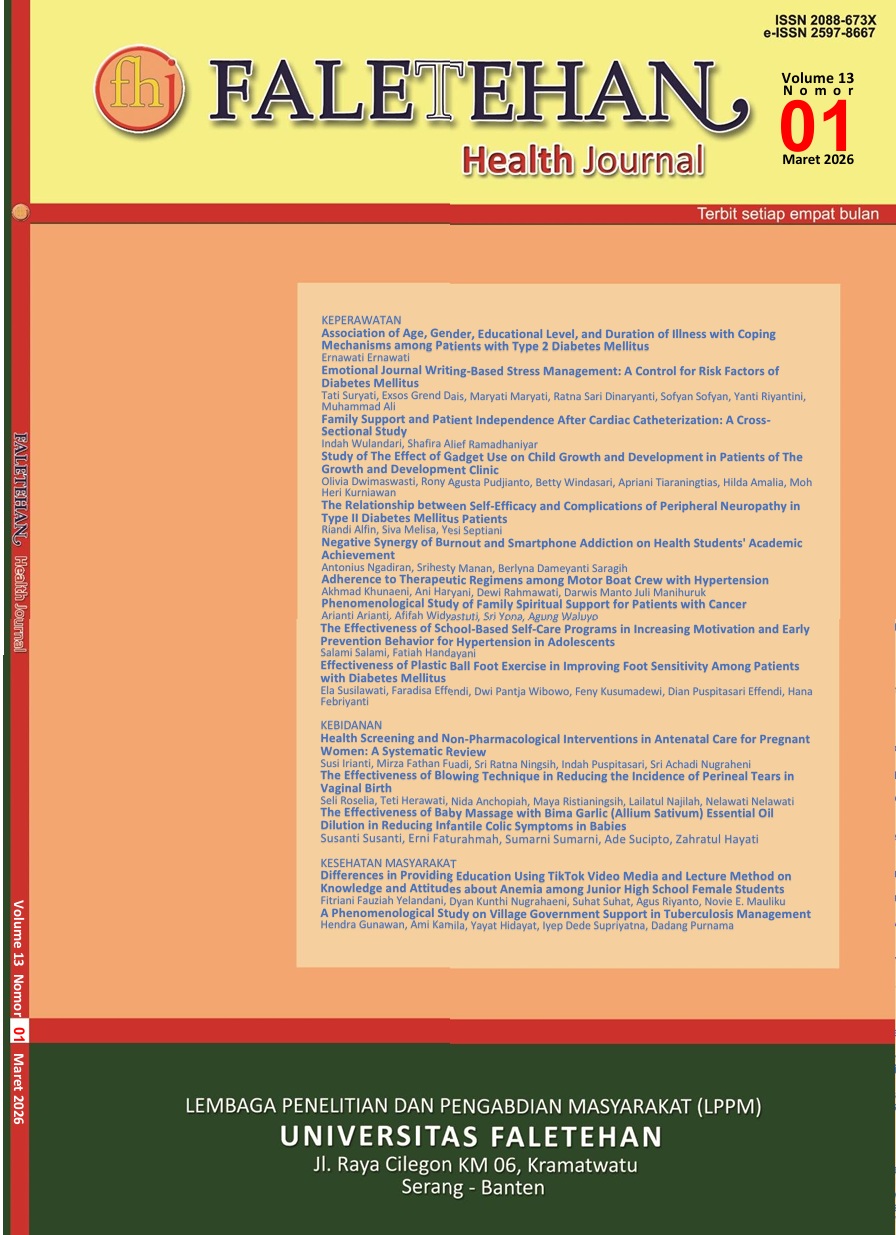
Negative Synergy of Burnout and Smartphone Addiction on Health Students' Academic Achievement
DOI:
https://doi.org/10.33746/fhj.v13i01.918Keywords:
academic achievement, burnout, smartphone addiction, studentsAbstract
High academic pressure in health sciences colleges poses a risk of causing emotional exhaustion or burnout and encouraging maladaptive behaviors such as smartphone addiction. Both factors are often considered as major obstacles to students' academic achievement. This study was conducted to analyze the simultaneous influence of burnout and smartphone addiction on students' academic performance. This is a quantitative study with a cross-sectional design, involving 300 health sciences students as respondents who were selected using the purposive sampling technique and the Slovin formula with a margin of error of about 5% (0.05). Data analysis was performed using path analysis to test the influence between variables. Research findings indicated that burnout has a significant negative effect on academic achievement (b = -0.264; p = 0.000), suggesting that higher levels of academic exhaustion lead to lower student GPA. Conversely, smartphone addiction was not found to have a significant direct influence on academic achievement (p = 0.514). This study concluded that burnout is the primary predictor that negatively impacts the academic outcomes of health sciences students. Therefore, educational institutions need to prioritize stress management programs and burnout prevention interventions to maintain the stability of students' academic performance.
Downloads
References
Amez, S., & Baert, S. (2020). Smartphone use and academic performance: A literature review. Educational Research Review, 31, 100336.
Arthy, C., Effendy, E., Amin, M. M., & Loebis, S. P. (2019). Indonesian version of addiction rating scale of smartphone usage adapted from smartphone addiction scale-short version (SAS-SV). Open Access Macedonian Journal of Medical Sciences, 7(19), 3235–3239.
Borah, S., & Kalita, H. C. (2025). Digital Detox: Path to a Healthier, Happier Life. International Journal of Applied Home Science, 12(9–10), 515–518.
Dianti, M., & Findyartini, A. (2019). Burnout syndrome in medical students: prevalence and associated factors. Medical Journal of Indonesia, 28(1), 46–52.
Erschens, R., Keifenheim, K. E., Herrmann-Werner, A., Loda, T., Schwille-Kiuntke, J., Bugaj, T. J., & Junne, F. (2019). Professional burnout among medical students: Systematic literature review and meta-analysis. Medical Teacher, 41(1), 54–63.
Frajerman, A., Morvan, Y., Krebs, M. O., Gorwood, P., & Chaumette, B. (2019). Burnout in medical students before residency: A systematic review and meta-analysis. European Psychiatry, 55, 36–42.
Gavelin, H. M., Neely, A. S., Dunér, J., & Stigsdotter Neely, A. (2022). Cognitive function in clinical burnout: A systematic review and meta-analysis. Work & Stress, 36(4), 400–420.
Geng, Y., Gu, J., Wang, J., & Zhang, R. (2021). Smartphone addiction and depression, anxiety: The role of bedtime procrastination and positive coping style among college students. Psychiatry Research, 304, 114139.
Hadžibajramović, E., Schaufeli, W., & De Witte, H. (2024). The ultra-short version of the Burnout Assessment Tool (BAT4)-development, validation, and measurement invariance across countries, age and gender. PLoS ONE, 19(2 February). https://doi.org/10.1371/journal.pone.0297843
Hair, J. F., Hult, G. T. M., Ringle, C. M., & Sarstedt, M. (2022). A primer on partial least squares structural equation modeling (PLS-SEM) (3rd ed.). Sage Publications.
Hobfoll, Stevan E. and Halbesleben, Jonathon and Neveu, Jean-Pierre and Westman, & Mina. (2018). Conservation of resources in the organizational context: The reality of resources and their consequences. Annual Review of Organizational Psychology and Organizational Behavior, 44(3), 103–128.
Jannah, W., Rivai, H. A., & Syahrul, L. (2024). The effect of motivation and self-efficacy on academic performance with burnout as a mediation variable. Jurnal Mantik, 8(1), 9–15.
Kaggwa, M. M., Arinaitwe, I., Najjuka, S. M., Sindani, H. A., Tugume, P., Muwanguzi, M., & Griffiths, M. D. (2021). Prevalence and factors associated with burnout among medical students in Uganda: A cross-sectional study. Advances in Medical Education and Practice, 12, 1157–1165.
Kates, A. W., Wu, H., & Coryn, C. L. S. (2018). The effects of mobile phone use on academic performance: A meta-analysis. Computers & Education, 127, 107–112.
Kirikkanat, B., & Soyer, M. K. (2018). Examination of the relationship between academic burnout and academic achievement. Universal Journal of Educational Research, 6(4), 817–821.
Kwon, M., Kim, D.-J., Cho, H., & Yang, S. (2013). The smartphone addiction scale: Development and validation of a short version for adolescents. PLoS ONE, 8(12), e83558.
Madigan, D. J., & Curran, T. (2021). Does burnout affect academic achievement? A meta-analysis of over 100,000 students. Educational Psychology Review, 33(2), 387–405.
Maslach, C., & Leiter, M. P. (2021). How to measure burnout accurately and ethically. Harvard Business Review, 99(2), 2–5.
Morcos, G., & Awan, O. A. (2023). Burnout in medical school: A medical student’s perspective. Academic Radiology, 30(6), 1223–1225.
Putri, T. A., & others. (2021). Hubungan tingkat stres dengan kejadian burnout pada mahasiswa kedokteran. Jurnal Medika, 7(1).
Rozgonjuk, D., Saal, K., & Täht, K. (2018). Problematic smartphone use, deep and surface approaches to learning, and social media use in lectures. International Journal of Environmental Research and Public Health, 15(1), 92.
Schneider, M., & Preckel, F. (2017). Variables associated with achievement in higher education: A systematic review of meta-analyses. Psychological Bulletin, 143(6), 565–600.
Sunday, O. J., Adesope, O. O., & Maarouf, P. B. (2021). The effects of smartphone addiction on learning: A meta-analysis. Computers in Human Behavior Reports, 4, 100114.
Downloads
Published
How to Cite
Issue
Section
License
Authors retain copyright and grant the journal the right of first publication. This work is licensed under a Creative Commons Attribution 4.0 International License (CC BY 4.0), which permits use, distribution, and reproduction in any medium, provided the original author and source are properly cited.
