
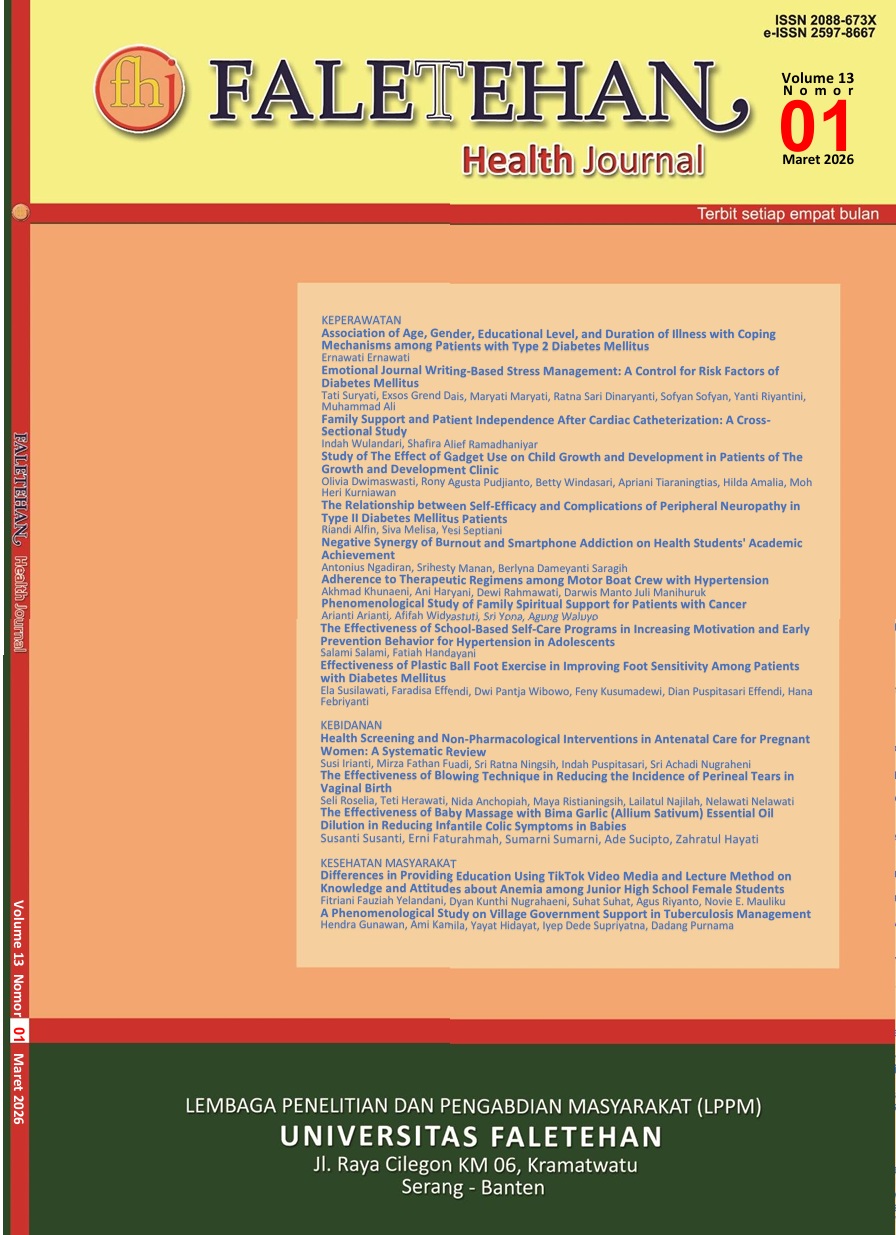
The Effectiveness of Baby Massage with Bima Garlic (Allium Sativum) Essential Oil Dilution in Reducing Infantile Colic Symptoms in Babies
DOI:
https://doi.org/10.33746/fhj.v13i01.907Keywords:
infantile colic, baby massage, Allium sativum, essential oil, complementary therapyAbstract
Infantile colic is one of the common health problems experienced by infants in early life, characterized by excessive crying and difficulty being soothed. Garlic (Allium Sativum) is known to contain bioactive compounds that potentially provide antispasmodic,carminative, and anti-inflammatory effects. Aim of this study was to examine the effectiveness of baby massage with Bima garlic (Allium Sativum) essential oil dilution in reducing infantile colic symptoms in babies. This study employed a quasi-experimental design with a pre-test–post-test control group design. The sample consisted of 50 infants divided into two groups: experimental group (n =25) that received baby massage with Bima garlic essential oil dilution and control group (n= 25) that received baby massage without oil. The results showed a significant reduction in colic symptoms in both groups after the intervention. However, the decrease was greater in the experimental group. Statistical analysis indicated a significant difference in post-test scores between the experimental and the control group (p < 0.001). This intervention may be considered an evidence-based, locally grounded complementary therapy that is safe, affordable, and easy to implement in pediatric nursing practice.
Downloads
References
(2020). Infantile colic and maternal mental health: A cross-sectional study. Middle East Current Psychiatry, 27, 32. https://doi.org/https://doi.org/10.1186/s43045-020-00045-1
Batiha, G. E., et al. (2020). Chemical constituents and pharmacological activities of garlic. Nutrients, 12(3), 872.
Bayan, L., Koulivand, P. H., & Gorji, A. . (2014). Garlic: a review of potential therapeutic effects. . Avicenna journal of phytomedicine, 4(1), 1.
Bennett, C., et al. (2018). Massage therapy for infants. Journal of Pediatric Nursing, 40, e1–e9.
Biagioli, E., et al. (2016). Probiotics and herbal therapies in infantile colic. Pediatrics, 137(6), e20153223.
Bilgin, A., & Wolke, D. (2020). Infant crying problems and symptoms of sleeping problems predict attachment disorganization at 18 months. Attachment & human development,, 22(4), 367-391.
Çetinkaya, B., & Başbakkal, Z. (2017). Effectiveness of massage therapy on infant colic. Journal of Clinical Nursing, 26(21–22), 3525–3533.
Field, T. (2019). Infant massage therapy. A narrative review Children, 6(4), 68. https://doi.org/https://doi.org/10.3390/children6040068
Gruber, C. W., & O'Brien, M. . (2011). Uterotonic plants and their bioactive constituents. Planta medica, 77(03), 207-220.
Hanieh S, H. T., et.al. (2015). The effect of herbal medicine on gastrointestinal disorders in infants: a randomized controlled trial. BMC Complement Altern Med, 15:182.
Indrio, F., et al. (2017). Probiotics in infantile colic. Journal of Pediatric Gastroenterology and Nutrition, 64(4), 511–515.
Johnson, J. D., Cocker, K., & Chang, E. (2015). Infantile colic: Recognition and treatment. American Family Physician, 92(7), 577–582.
Kartiningsih, D. (2020). Terapi Komplementer. EGC.
Kemenkes, R. (2023). Profil Kesehatan Indonesia.
Kulkarni, A., et.al. . (2010). Massage and touch therapy in neonates. the current evidence. Indian pediatrics, 47(9), 771-776.
Martinelli, M., et al. (2020). Complementary therapies for infant colic. Children, 7(6), 53.
Miller, J., McVeigh, C., & Morris, H. (2021). The impact of infant colic on maternal mental health: A systematic review. Journal of Pediatric Nursing, 61, 1–8. . https://doi.org/https://doi.org/10.1016/j.pedn.2021.06.009
Nasir M, e. a. (2013). Garlic oil and colic in babies. Journal Altern Complement Med, 19(2), 121-125.
Nurrahman M, e. a. (2022). Etnobotani Herbal NTB. Bioeksperimen, 8(1), 40–48.
Perry, R., et al. (2019). Herbal medicines for infant colic. . BMC Complementary Medicine and Therapies, 19, 1–9.
Petrovska, B. B. (2017). Historical review of medicinal plants’ usage. Pharmacognosy Reviews, 11(22), 103–108.
Saeidi R, e. a. (2015). The effect of infant massage on colic symptoms in infants. Journal Isfahan Med Sch, 32(322), 1–8.
Savino, F., Ceratto, S., De Marco, A., & Savino, A. . (2018). Looking for new treatments of infantile colic. Italian journal of pediatrics, 44(1), 1–8.
Savino, F., et.al. (2014). Looking for new treatments of Infantile Colic. Italian journal of pediatrics, 40(1), 53.
Shang, A., et al. (2019). Bioactive compounds and health benefits of garlic. Foods, 8(7), 246.
Sharifi-Rad, J., et al. (2020). Therapeutic potential of garlic. Phytotherapy Research, 34(7), 1633–1652.
Shorey, S., & Chan, S. W. C. (2017). The experiences and needs of Asian first-time mothers’ postnatal period: A systematic review and meta-synthesis. Patient Education and Counseling, 100(12), 2204–2216. https://doi.org/https://doi.org/10.1016/j.pec.2017.06.026
Sung, V., et al. (2018). Infantile colic. BMJ, 361, k1747.
Sung, V., et.al. (2014). Treating infant colic with the probiotic Lactobacillus reuteri: double blind, placebo controlled randomised trial. BMJ, 348.
Syahrul, A., et.al. (2021). Potensi Bawang Putih Khas Bima. Jurnal Ilmu Alam, 5(2), 78–85.
Tekgündüz, K. Ş., et al. (2017). Effect of massage therapy on infantile colic. Journal of Clinical Nursing, 26(3–4), 406–412.
Vandenplas, Y., et al. (2015). Systematic review of infantile colic. Journal of Pediatric Gastroenterology and Nutrition, 61(5), 531–539.
Widyaningsih S, e. a. (2021). Aromaterapi dalam Keperawatan Anak. Jurnal Kesehatan Anak, 9(2), 89–95.
Downloads
Published
How to Cite
Issue
Section
License
Authors retain copyright and grant the journal the right of first publication. This work is licensed under a Creative Commons Attribution 4.0 International License (CC BY 4.0), which permits use, distribution, and reproduction in any medium, provided the original author and source are properly cited.
