
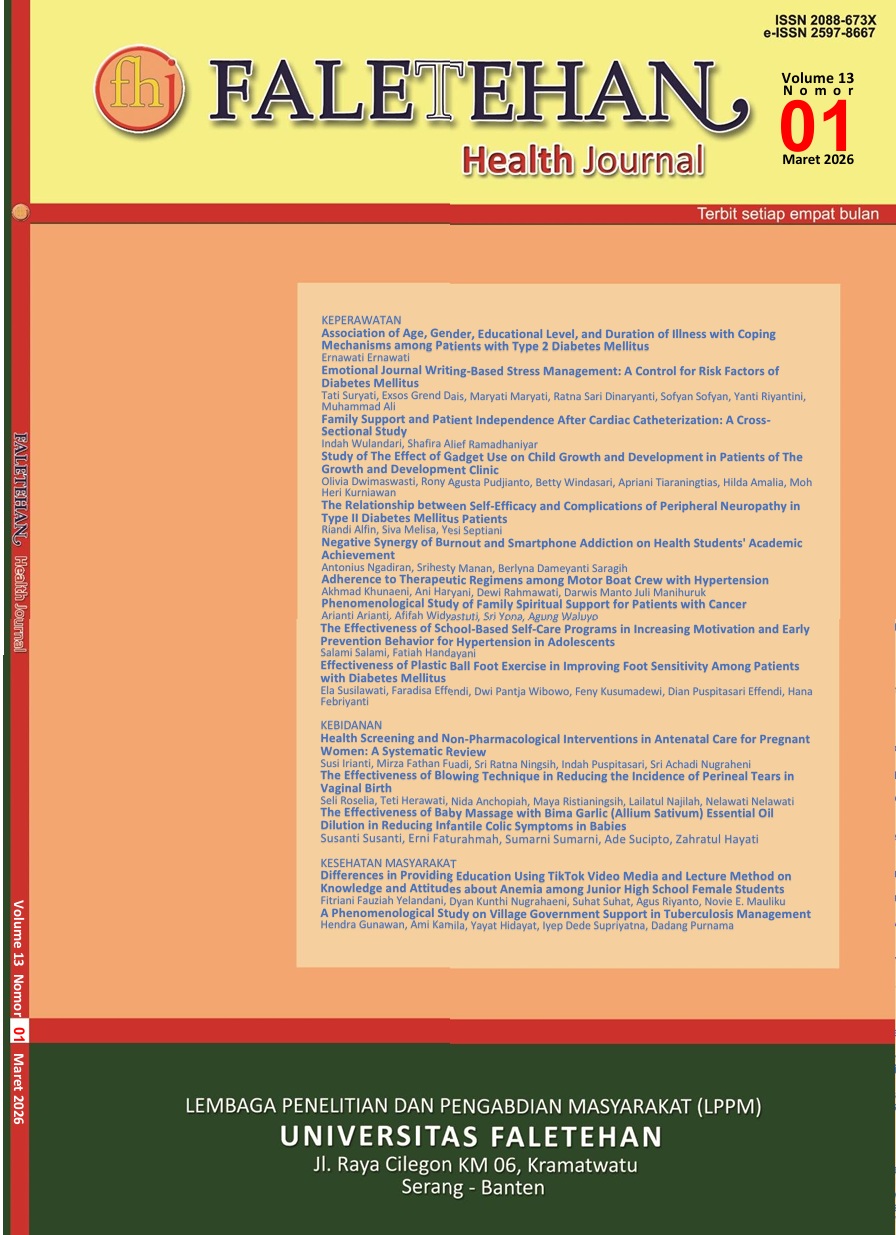
Association of Age, Gender, Educational Level, and Duration of Illness with Coping Mechanisms among Patients with Type 2 Diabetes Mellitus
Keywords:
age, coping mechanisms, diabetes mellitus, duration of illness, educational levelAbstract
Studies showed that diabetes-related distress and coping are influenced by sociodemographic and illness-related factors. This study examined the associations of age, gender, educational level, and duration of illness with coping mechanisms among patients with T2DM. This quantitative analytic study used a cross-sectional design and was conducted at Singandaru Public Health Center, Serang City from April to May 2023. A total of 30 respondents were recruited using total sampling. Data were collected using a 20-item coping-mechanism questionnaire scored on a Likert scale. Univariate analysis was used to describe respondent characteristics, bivariate analysis to assess associations between independent variables and coping mechanisms, and multivariate analysis to identify the most dominant factor. Most respondents were 46-55 years old (63.3%), female (53.3%), had junior high school education (43.3%), had been living with diabetes for 2 years (43.3%), and demonstrated adaptive coping mechanisms (80.0%). Bivariate analysis showed significant associations between coping mechanisms and age (p < .001), gender (p = .044), educational level (p = .001), and duration of illness (p = .032). In the multivariate model, age remained the most dominant factor (B = -0.693, p = .023). Age, gender, educational level, and duration of illness were significantly associated with coping mechanisms among patients with T2DM, with age emerging as the strongest predictor. These findings highlight the need for primary-care interventions that integrate psychosocial assessment, tailored education, and emotional support.
Downloads
References
Aljuaid, M. O., Almutairi, A. M., Assiri, M. A., Almalki, D. M., & Alswat, K. (2018). Diabetes-related distress assessment among type 2 diabetes patients. Journal of Diabetes Research, 2018, Article 7328128. https://doi.org/10.1155/2018/7328128
Arifin, B., van Asselt, A. D. I., Setiawan, D., Atthobari, J., Postma, M. J., & Cao, Q. (2019). Diabetes distress in Indonesian patients with type 2 diabetes: A comparison between primary and tertiary care. BMC Health Services Research, 19, Article 773. https://doi.org/10.1186/s12913-019-4515-1
Bhaskara, G., Budhiarta, A. A. G., Gotera, W., Saraswati, M. R., Dwipayana, I. M. P., Semadi, I. M. S., Nugraha, I. B. A., Wardani, I. A. K., & Suastika, K. (2022). Factors associated with diabetes-related distress in type 2 diabetes mellitus patients. Diabetes, Metabolic Syndrome and Obesity: Targets and Therapy, 15, 2077-2085. https://doi.org/10.2147/DMSO.S363431
Captieux, M., Pearce, G., Parke, H. L., Epiphaniou, E., Wild, S., Taylor, S. J. C., & Pinnock, H. (2018). Supported self-management for people with type 2 diabetes: A meta-review of quantitative systematic reviews. BMJ Open, 8(12), e024262. https://doi.org/10.1136/bmjopen-2018-024262
Chew, B.-H., Vos, R., Mohd-Sidik, S., & Rutten, G. E. H. M. (2016). Diabetes-related distress, depression and distress-depression among adults with type 2 diabetes mellitus in Malaysia. PLoS ONE, 11(3), e0152095. https://doi.org/10.1371/journal.pone.0152095
Freeman-Hildreth, Y., Aron, D., Cola, P. A., & Wang, Y. (2019). Coping with diabetes: Provider attributes that influence type 2 diabetes adherence. PLoS ONE, 14(4), e0214713. https://doi.org/10.1371/journal.pone.0214713
German, J., Kobe, E. A., Lewinski, A. A., Jeffreys, A. S., Coffman, C. J., Edelman, D., Batch, B. C., & Crowley, M. J. (2023). Factors associated with diabetes distress among patients with poorly controlled type 2 diabetes. Journal of the Endocrine Society, 7(5), bvad031. https://doi.org/10.1210/jendso/bvad031
Hagger, M. S., & Orbell, S. (2022). The commonsense model of illness self-regulation: A conceptual review and proposed extended model. Health Psychology Review, 16(3), 347-377. https://doi.org/10.1080/17437199.2021.1878050
Huynh, G., Tran, T. T., Do, T. H. T., Truong, T. T. D., & Ong, P. T. (2021). Diabetes-related distress among people with type 2 diabetes in Ho Chi Minh City, Vietnam: Prevalence and associated factors. Diabetes, Metabolic Syndrome and Obesity: Targets and Therapy, 14, 683-690. https://doi.org/10.2147/DMSO.S297315
Leventhal, H., Phillips, L. A., & Burns, E. (2016). The common-sense model of self-regulation (CSM): A dynamic framework for understanding illness self-management. Journal of Behavioral Medicine, 39(6), 935-946. https://doi.org/10.1007/s10865-016-9782-2
McCoy, M. A., & Theeke, L. A. (2019). A systematic review of the relationships among psychosocial factors and coping in adults with type 2 diabetes mellitus. International Journal of Nursing Sciences, 6(4), 468-477. https://doi.org/10.1016/j.ijnss.2019.09.003
Perrin, N., Bodicoat, D. H., Davies, M. J., Robertson, N., Snoek, F. J., & Khunti, K. (2019). Effectiveness of psychoeducational interventions for the treatment of diabetes-specific emotional distress and glycaemic control in people with type 2 diabetes: A systematic review and meta-analysis. Primary Care Diabetes, 13(6), 556-567. https://doi.org/10.1016/j.pcd.2019.04.001
Zu, W., Zhang, S., Du, L., Huang, X., Nie, W., & Wang, L. (2024). The effectiveness of psychological interventions on diabetes distress and glycemic level in adults with type 2 diabetes: A systematic review and meta-analysis. BMC Psychiatry, 24, Article 660. https://doi.org/10.1186/s12888-024-06125-z
Downloads
Published
How to Cite
Issue
Section
License
Copyright (c) 2026 Ernawati Ernawati

This work is licensed under a Creative Commons Attribution 4.0 International License.
Authors retain copyright and grant the journal the right of first publication. This work is licensed under a Creative Commons Attribution 4.0 International License (CC BY 4.0), which permits use, distribution, and reproduction in any medium, provided the original author and source are properly cited.
