
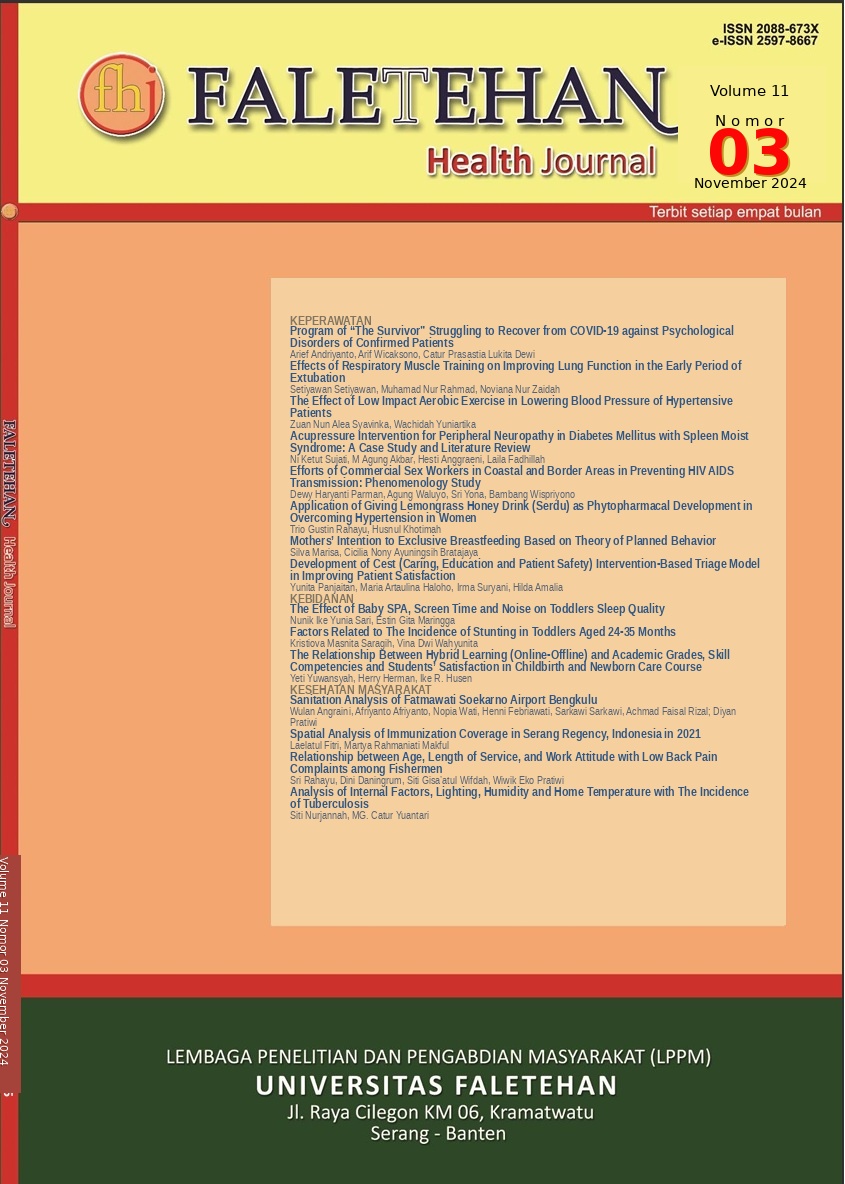
Mothers’ Intention to Exclusive Breastfeeding Based on Theory of Planned Behavior
DOI:
https://doi.org/10.33746/fhj.v11i03.449Keywords:
exclusive breastfeeding, infants, breastfeeding intention, theory of planned behaviorAbstract
Exclusive breastfeeding coverage in Indonesia had not reached the target yet. One of the things that determines the success of mothers in providing exclusive breastfeeding is intention. The study aimed to identify factors related to mother's intention to exclusive breastfeeding based on Theory of Planned Behavior (TPB). This quantitative study used a cross-sectional design. The population were mothers who had 0-6 months old babies. The purposive sampling technique was employed to 124 respondents. The TPB-based questionnaire was made up. The results of the study showed that majority of respondents (107 mothers or 86.3%) had a strong intention to exclusive breastfeeding. The result of data analysis using Kendall's Tau B showed that there was a relationship between attitudes (p-value = 0.000; p < 0.05), perceived perception control (p-value = 0.000; p < 0.05), and intention to exclusive breastfeeding. However, there was no relationship between subjective norms (p-value 0.723; p < 0.05) and intention to exclusive breastfeeding. Thus, health providers should enhance mothers’ awareness through health promotion, and breastfeeding facilities should be available to support exclusive breastfeeding coverage.
Downloads
References
Ajzen, I. (2005). Attitude, Personality and Behavior Second (1 ed.). Open University Press.
Bratajaya, C. N. A., Hemchayat, M., & Turner, K. (2015). Predictors of intention to practice exclusive breastfeeding among pregnant working women in Jakarta, Indonesia. Journal of Health Research, 29(Suppl. 1), S69–S75.
Chipojola, R., Chiu, H.-Y., Huda, M. H., Lin, Y.-M., & Kuo, S.-Y. (2020). Effectiveness of theory-based educational interventions on breastfeeding self-efficacy and exclusive breastfeeding: A systematic review and meta-analysis. International Journal of Nursing Studies, 109, 103675.
Dinkes DKI Jakarta. (2020). Profil Kesehatan Provinsi DKI Jakarta Tahun 2020. Dinas Kesehatan.
Fitri, D. I., Chundrayetti, E., & Semiarty, R. (2014). Hubungan pemberian ASI dengan tumbuh kembang bayi umur 6 bulan di Puskesmas Nanggalo. Jurnal Kesehatan Andalas, 3(2).
Fitriana, E. S., & Mubarokah, K. (2017). Faktor-faktor yang Berhubungan dengan Niat Ibu Hamil untuk Memberikan ASI Eksklusif di Puskesmas Tlogosari Kulon Tahun 2017. Prodi Kesehatan Masyarakat - S1, UDINUS.
Giles, M., Connor, S., McClenahan, C., Mallett, J., Stewart-Knox, B., & Wright, M. (2007). Measuring young people’s attitudes to breastfeeding using the Theory of Planned Behaviour. Journal of Public Health, 29(1), 17–26.
Hajeebhoy, N. (2016). The Lancet breastfeeding series. World Health Organization.
Hmone, M. P., Li, M., Agho, K., Alam, A., & Dibley, M. J. (2017). Factors associated with intention to exclusive breastfeed in central women’s hospital, Yangon, Myanmar. International breastfeeding journal, 12(1), 1–12.
Ismail, T. A. T., Muda, W. A. M. W., & Bakar, M. I. (2016). The extended Theory of Planned Behavior in explaining exclusive breastfeeding intention and behavior among women in Kelantan, Malaysia. Nutrition research and practice, 10(1), 49–55.
Jatmika, S. E. D., Shaluhiyah, Z., & Suryoputro, A. (2014). Dukungan tenaga kesehatan untuk meningkatkan niat ibu hamil dalam memberikan ASI eksklusif di Wilayah Kerja Puskesmas Gondokusuman, Kota Yogyakarta. Jurnal Promosi Kesehatan Indonesia, 9(2), 196–205.
Kemenkes RI. (2017). Menyusui Dapat Menurunkan Angka Kematian Bayi. https://sehatnegeriku.kemkes.go.id/baca/rilis-media/20170809/0122144/menyusui-dapat-menurunkan-angka-kematian-bayi/
Kementerian Kesehatan Republik Indonesia. (2020). Profil Kesehatan Indonesia Tahun 2019. Kementerian Kesehatan Republik Indonesia.
Mamangkey, S. J. F., Rompas, S., & Masi, G. (2018). Hubungan Dukungan Keluarga dengan Pemberian ASI Eksklusif pada Bayi di Puskesmas Ranotana Weru. Jurnal Keperawatan, 6(1).
Mustafyani, A. D., & Mahmudiono, T. (2017). Hubungan pengetahuan, sikap, dukungan suami, kontrol perilaku, dan niat ibu dengan perilaku kadarzi ibu balita gizi kurang. The Indonesian Journal of Public Health, 12(2), 190–201.
Sulaeman, E. S., Murti, B., Setyawan, H., & Rinawati, S. (2018). Exclusive breastfeeding behavior model in rural Central Java, Indonesia: the application of theory of planned behavior. Global Journal of Health Science, 10(10), 35–49.
Sutisna, E. (2017). Aplikasi Theory of Planned Behavior Pada Perilaku Pemberian ASI Eksklusif: Studi Kasus. Jurnal Kedokteran YARSI, 25(2), 84–100.
World Health Organization. (2020). Breastfeeding and COVID-19: scientific brief, 23 June 2020 (No. WHO/2019-nCoV/Sci_Brief/Breastfeeding/2020.1). World Health Organization.
Yusrina, A., & Devy, S. R. (2016). Faktor yang mempengaruhi niat ibu memberikan ASI eksklusif di Kelurahan Magersari, Sidoarjo. Jurnal Promkes: The Indonesian Journal of Health Promotion and Health Education, 4(1), 11–21.
Zhang, Z., Zhu, Y., Zhang, L., & Wan, H. (2018). What factors influence exclusive breastfeeding based on the theory of planned behaviour. Midwifery, 62, 177–182.
Downloads
Published
How to Cite
Issue
Section
License
Authors retain copyright and grant the journal the right of first publication. This work is licensed under a Creative Commons Attribution 4.0 International License (CC BY 4.0), which permits use, distribution, and reproduction in any medium, provided the original author and source are properly cited.
